
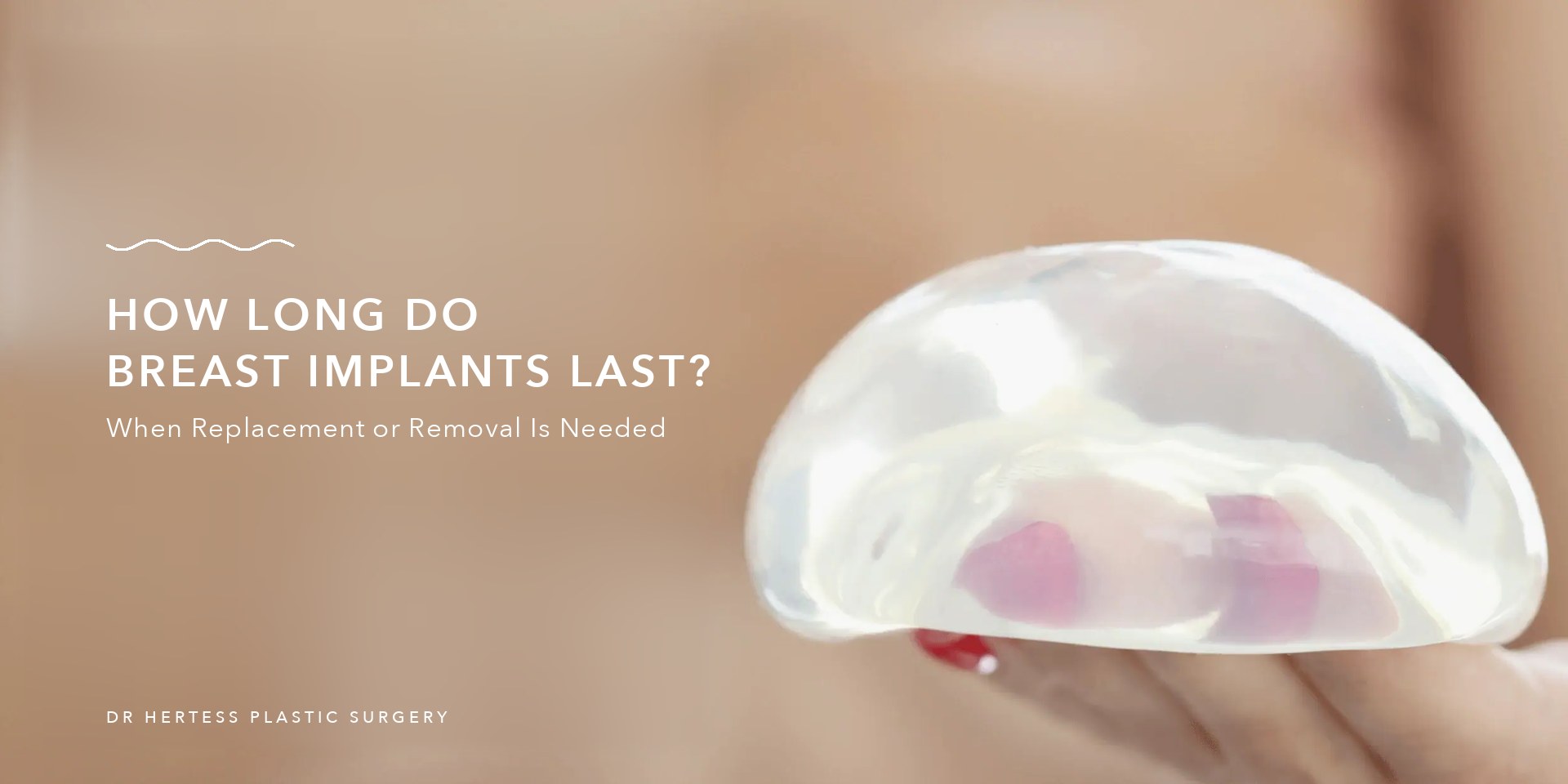
“How long do breast implants last?” is one of the most common questions Dr Isolde Hertess hears in consultation, usually followed by “do breast implants need to be replaced automatically at some point?” The honest answer is that implants don’t come with a fixed use-by date.
Most modern implants last well over a decade, and replacement is guided by what your breasts and implants are doing, not by a number on the calendar.
Quick Answer
- Most modern breast implants last many years, often well beyond 10, though no implant is designed to last a lifetime.
- Do breast implants need to be replaced on a set schedule? No – replacement is based on clinical signs, not age alone.
- Signs worth having checked include a change in shape or size, new firmness, visible rippling, or unusual swelling.
- Long-term monitoring matters more than any fixed timeframe, since some changes (like silent rupture) don’t cause obvious symptoms.
- If replacement is needed, it’s often combined with other procedures depending on what your breasts need.
How Long Do Breast Implants Last?
There’s no built-in expiry date on a breast implant. How long breast implants last depends on the individual – the implant type and shell quality, your anatomy, weight changes, pregnancy, and the original surgical technique all play a part.
Many women carry the same implants comfortably for well over a decade without any clinical reason to change them.
The “10-Year Rule” Myth
You may have heard that implants must be swapped out every 10 years. This idea largely comes from older-generation implants and early manufacturer data, rather than current evidence.
Modern shell technology has improved considerably, and Australian guidance – including monitoring recommended through the Therapeutic Goods Administration (TGA) and the Australian Breast Device Registry (ABDR) – focuses on regular review rather than automatic replacement at a set age.
If your implants look, feel and check out as expected, there’s usually no reason to replace them purely because a certain number of years has passed.
Do Breast Implants Need to Be Replaced? Signs to Watch For
Rather than working to a timeline, it’s more useful to know what to look out for. Reasons breast implants may need to be replaced include:
- A noticeable change in breast shape, size or symmetry
- New firmness, tightness or discomfort, which can suggest capsular contracture
- Visible or palpable rippling at the edge of the implant
- Swelling or fluid build-up that wasn’t there before
- A suspected rupture – silicone ruptures are often silent and are usually picked up through imaging rather than symptoms
If you notice any of these, it’s worth having your implants assessed rather than waiting to see whether it settles on its own.
What Happens If Replacement or Removal Is Needed
Aged breast implants that have developed a complication, or implants that a patient simply wants to change, don’t all need the same approach.
Some patients opt for breast implant removal and replacement, exchanging for a new implant, sometimes with a different size or type. Others choose removal of breast implants without replacement, particularly if they’d prefer to return to a more natural breast size. Dr Hertess talks through what’s involved with aged breast implants specifically, including how capsular tissue and implant condition factor into the decision.
Depending on your anatomy and goals, replacement is sometimes combined with a lift. Breast augmentation with a lift may be considered when skin laxity or a change in breast position has developed alongside the implant itself, so the two are addressed together rather than in separate surgeries.
Staying on Top of Long-Term Monitoring
Because some changes, like a silent silicone rupture, don’t come with obvious symptoms, ongoing monitoring is the safety net that a fixed replacement schedule can’t replace.
This generally means periodic self-checks, regular review with your surgeon or GP, and imaging as recommended for your implant type.
Registering with the Australian Breast Device Registry (ABDR) also means your implant details are tracked as part of Australia’s broader safety monitoring, which is worth asking about if you’re not sure whether yours are recorded.
Considering Your Next Step?
Whether you’re wondering how long your breast implants will last, noticing a change worth checking, or thinking about replacement or removal, Dr Isolde Hertess can talk you through what’s going on with your implants rather than what the calendar suggests.
Discover Gold Coast cosmetic surgery with Dr Hertess, or call (07) 5601 0492 to arrange a consultation.
This article provides general information only and is not a substitute for individual medical advice. All surgery carries risks, and individual results vary. AHPRA Registration: MED0001372020.

Dr Isolde Hertess is a Specialist Plastic and Reconstructive Surgeon (FRACS (Plast.)) practising on the Gold Coast and in Cairns, with more than 30 years of experience in breast, body, face and reconstructive surgery. She graduated in medicine and science from the University of Melbourne in 1986 and became a Fellow of the Royal Australasian College of Surgeons in Plastic and Reconstructive Surgery in 1993. Her work has a particular focus on breast surgery, including complex and revisional cases, and skin cancer surgery. She is a member of the Australian Society of Plastic Surgeons (ASPS) and the Australasian Society of Aesthetic Plastic Surgeons (ASAPS).
AHPRA Registration: MED0001372020 | Specialist Registration: Surgery (Plastic Surgery)

Read more about Dr Hertess →