
If you’re considering breast reduction surgery, two questions tend to come up before anything else: how long is breast reduction recovery going to take, and what will the scars actually look like?
Dr Isolde Hertess, Specialist Plastic & Reconstructive Surgeon on the Gold Coast, talks through both honestly with every patient, because informed decisions start with realistic expectations rather than guesswork.
Quick Answer
- Breast reduction recovery happens in stages: the first couple of weeks focus on rest and wound healing, with lighter activities returning gradually over the following weeks.
- Swelling, bruising and tightness across the chest are normal in early recovery and settle over time.
- Breast reduction scars are visible and permanent, though they typically soften, flatten and fade over 6 to 12 months, sometimes longer.
- Scar pattern and final appearance depend on your anatomy, the amount of tissue removed, and how your body heals – no two patients are identical.
- Regular follow-up with your surgeon protects your results far more than any generic recovery calendar does.
What Does Breast Reduction Recovery Actually Involve?
Breast reduction recovery is rarely a single, tidy timeline. It’s a gradual process that unfolds differently for each patient, though most people move through similar broad stages.
The First Couple of Weeks
Early breast reduction recovery centres on rest. Expect some swelling, bruising and tightness across the chest, along with prescribed pain relief to keep you comfortable. A supportive surgical bra is usually worn day and night during this period, and lifting, reaching overhead and strenuous movement are best avoided while the incisions settle.
Returning to Normal Activities
As healing progresses, light daily tasks generally return before exercise does, with strenuous activity and heavy lifting waiting longer. Exact timing depends on how your individual recovery is tracking, which is why follow-up appointments matter so much during breast reduction recovery – they let your surgeon check healing and adjust advice as you go, rather than working off a generic calendar.
What Do Breast Reduction Scars Really Look Like?
Scarring is an unavoidable part of any breast reduction, because reshaping the breast and repositioning the nipple both require incisions.
The pattern used – whether an anchor-shaped incision, a vertical “lollipop” pattern, or a variation of either – depends on how much tissue needs to be removed and your existing breast shape, which Dr Hertess assesses and explains in detail on the Breast Reduction Surgery Gold Coast page and during consultation.
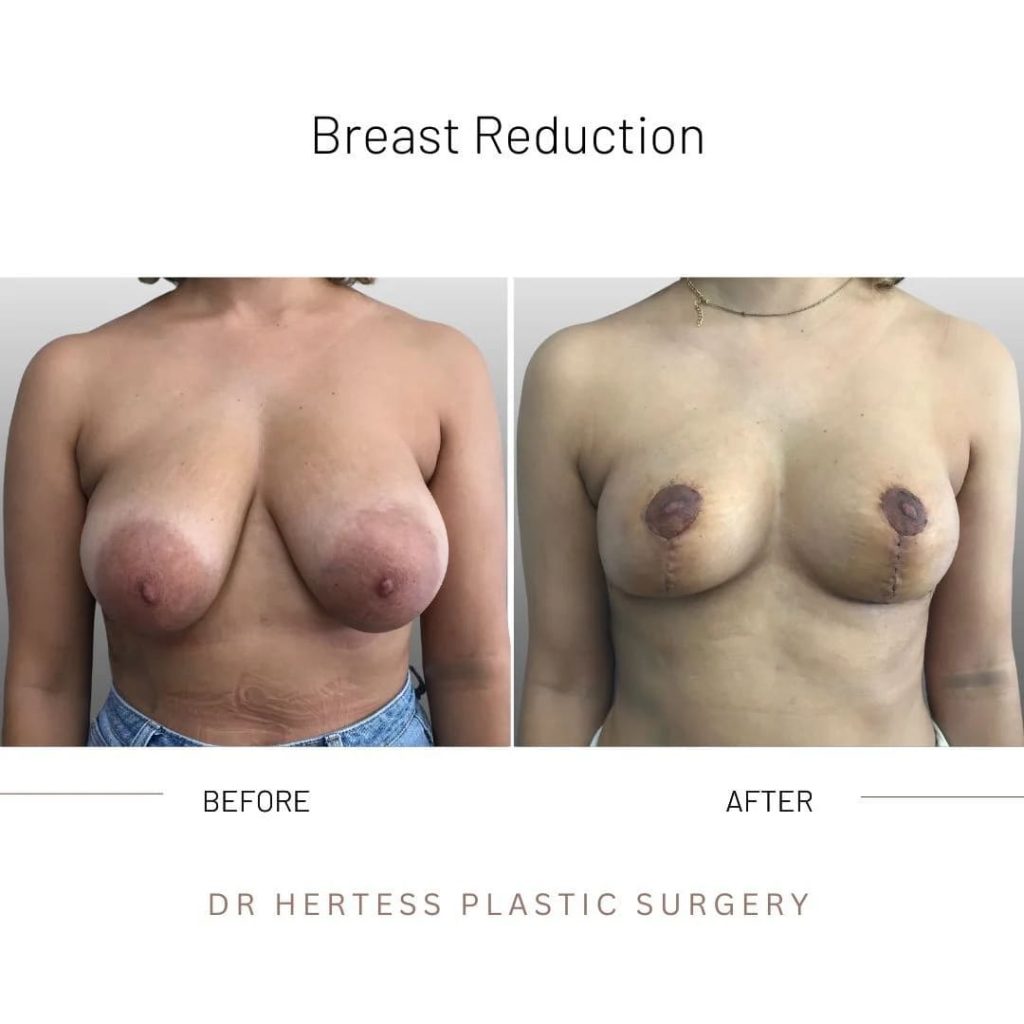
In the early months, breast reduction scars typically look pink, red or slightly raised – a normal part of healing, not a sign anything has gone wrong. Most scars then gradually flatten and lighten, though the full picture can take up to a year, sometimes longer, to become clear.
Genetics, skin type and how closely post-operative instructions are followed all play a role, which is why scarring varies between patients having a similar procedure.
Caring for Breast Reduction Scars During Recovery
A few habits make a genuine difference to how scars heal:
- Keep incisions clean and protected exactly as instructed, particularly in the first few weeks.
- Avoid direct sun exposure on healing scars, since UV exposure can darken them and prolong redness.
- Wear your surgical garment for as long as advised, even once you’re feeling back to normal.
- Be patient – scars often look their most obvious in the first few months, then continue improving for a year or more afterwards.
If you have questions about how a scar is healing at any stage, Dr Hertess’s team can talk you through what’s expected versus what’s worth having checked. Further detail on the healing process is also covered on the practice’s page on scarring after plastic surgery.
Considering Your Options Beyond Breast Reduction
Not everyone researching breast reduction recovery and scarring is set on that procedure alone.
Some are weighing up augmentation mastopexy – a lift combined with added volume – if reduced fullness rather than reduced size is the real concern.
Others are considering removal of breast implants alongside a lift, particularly if existing implants are causing discomfort.
A consultation is the best way to work out which path genuinely fits your anatomy and goals.
Ready to Talk Through Your Options?
Every recovery and every scar is different, which is why Dr Isolde Hertess talks patients through what to realistically expect before any decision is made.
If you’d like to discuss breast reduction recovery, scarring, or whether this procedure is right for you, enquire with the team or call (07) 5601 0492 to arrange a consultation with Dr Hertess’s Gold Coast practice.
This article provides general information only and is not a substitute for individual medical advice. All surgery carries risks, and individual results vary. AHPRA Registration: MED0001372020.

Dr Isolde Hertess is a Specialist Plastic and Reconstructive Surgeon (FRACS (Plast.)) practising on the Gold Coast and in Cairns, with more than 30 years of experience in breast, body, face and reconstructive surgery. She graduated in medicine and science from the University of Melbourne in 1986 and became a Fellow of the Royal Australasian College of Surgeons in Plastic and Reconstructive Surgery in 1993. Her work has a particular focus on breast surgery, including complex and revisional cases, and skin cancer surgery. She is a member of the Australian Society of Plastic Surgeons (ASPS) and the Australasian Society of Aesthetic Plastic Surgeons (ASAPS).
AHPRA Registration: MED0001372020 | Specialist Registration: Surgery (Plastic Surgery)

Read more about Dr Hertess →